Brainwaves, Stress Response, and Trauma
Last night I went to the hospital for a talk on "brainwaves, stress response, and trauma". I had really no clue what I was walking into, but it said it was open to the public and free with free parking, so I went. There was no more than 15 people there, and most seemed to know each other. The youngest was probably a college student.
The talk was an hour and a half long and was lead by Bryn Perkins, a doctory woman. She was supposed to have another speaker there, but due to snow, she couldn't make it.
Here is some of what I learned:
Neurons form synapses in the brain, which creates connections to form memory. They are helpful when learning to do something, because the more you do it, the easier it'll be. However, they also reinforce bad habits. Brainwaves are created when neurons "fire", or send impulses to each other. Because of that, the faster and harder your neurons are working, the higher frequency the brainwave is. Brianwaves can have different frequencies in different parts of your brain. It is typically better to have lower frequencies, because that allows us to be in a more calm, relaxed state of mind, vs the stress that is usually experienced when we have a lot of higher frequency brainwaves going on.
Generally, you want the amount/intensity of each frequency to be equal in the left and right sides of the brain. For example, when looking at the right and left frontal lobe, the intensity of alpha brainwaves (waves at a medium frequency) should be equal on each side. Same thing with higher and lower frequency brainwaves- it should be a mirror image of each other. We were shown graphs similar to this one to show this:
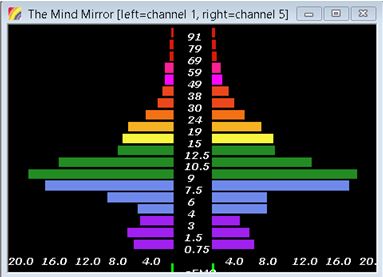
Up top are the higher frequency brainwaves, and they get slower as they go down the graph. You can see here that the right and left side are both equal. That's a good thing! It's how our brains are supposed to look. An unbalanced brain might look more like this:

See how uneven the purple is? An uneven brain can be caused by trauma, excessive stress, and head injuries, and can result in issues with the sympathetic and parasympathetic parts of the nervous system. That means, an imbalance of brainwaves with excess in the right side of the temporal lobe means that person is going to be in fight or flight mode more frequently. That can come through in aggression, stress, anxiety, fear, and many other mental and emotional feelings. The left side of the temporal lobe will activate more of a parasympathetic reaction- shutting down, feeling overwhelmed, feeling slow, a lack of motivation, etc. Having one side of the brain with this intensity of brainwaves can result in emotional struggles, digestion issues, trouble sleeping, and many other things. This is because the two sides of your brain need to work together equally, especially the sympathetic and parasympathetic system. When working together, the sympathetic, fight or flight response, keeps you alert, motivated, and energized, while the parasympathetic part keeps you calm and focused. It is very important for these parts of your brain to be able to function together!
So, how do you get these frequencies to match up evenly? Well, that's what this woman that gave the talk is doing! She works with a program/company called Cereset. What they do is essentially take your brainwaves from a certain part of your brain, turn it into sound, play it without all the excess that you don't want, and then have you listen back to it. Your brain listens and shifts its brainwaves to match the tone that's being played. It's similar to the way your body knows to heal when it has a cut- your brain wants to fix itself too! Sometimes it just needs a little help, and that is what playing back those brainwaves does.
Here's a really good graph that shows a before and after of that:
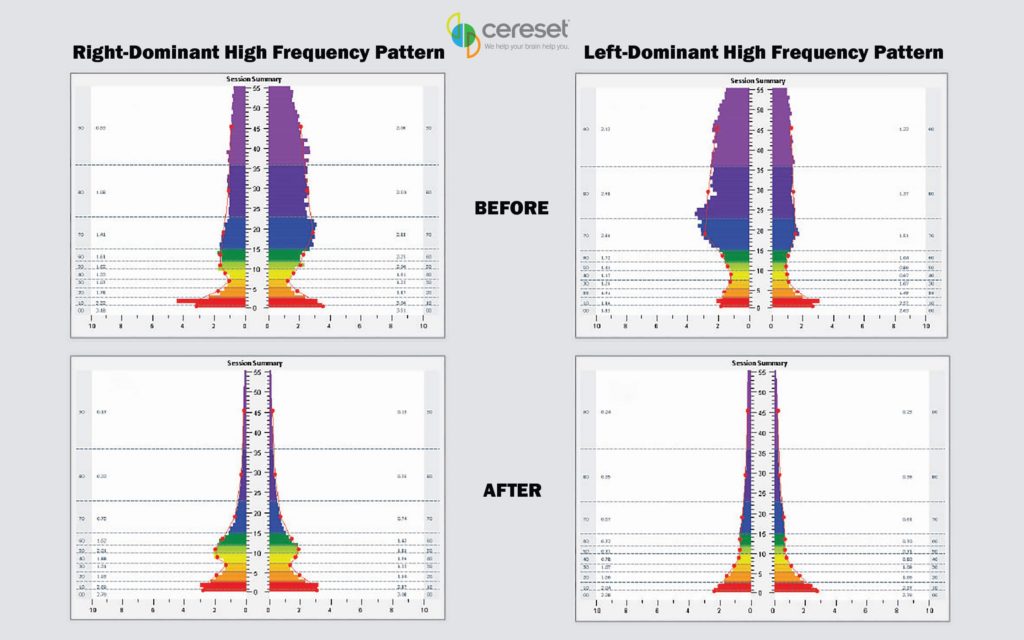
It's basically like a reset for your brain. It matches up your brainwaves to the same intensity so that the left and right sides of the brain can communicate and work together better. It evens your brain out, so you don't have to deal with excess stress or anxiety. It also solves some digestive issues, sleep problems, and restores energy and motivation. It also just makes you feel generally calmer, happier, better, etc...
Anyway, it was a really interesting night! I learned a lot, and it definitely challenged me, but not without being impossible to understand. I really enjoy learning about the brain and this was a fun experience for me! Plus, it was kind of nice to go to an event and get to pretend to be a little more grown-up than I am (like... getting the voucher for free parking). I think if there was another one of these talks that interested me, I would consider going! It would also be cool to go shadow this woman, and get to see her equipment and graphs in real life. Definitely was a great learning experience, and has given me lots of things to think about!
The talk was an hour and a half long and was lead by Bryn Perkins, a doctory woman. She was supposed to have another speaker there, but due to snow, she couldn't make it.
Here is some of what I learned:
Neurons form synapses in the brain, which creates connections to form memory. They are helpful when learning to do something, because the more you do it, the easier it'll be. However, they also reinforce bad habits. Brainwaves are created when neurons "fire", or send impulses to each other. Because of that, the faster and harder your neurons are working, the higher frequency the brainwave is. Brianwaves can have different frequencies in different parts of your brain. It is typically better to have lower frequencies, because that allows us to be in a more calm, relaxed state of mind, vs the stress that is usually experienced when we have a lot of higher frequency brainwaves going on.
Generally, you want the amount/intensity of each frequency to be equal in the left and right sides of the brain. For example, when looking at the right and left frontal lobe, the intensity of alpha brainwaves (waves at a medium frequency) should be equal on each side. Same thing with higher and lower frequency brainwaves- it should be a mirror image of each other. We were shown graphs similar to this one to show this:
Up top are the higher frequency brainwaves, and they get slower as they go down the graph. You can see here that the right and left side are both equal. That's a good thing! It's how our brains are supposed to look. An unbalanced brain might look more like this:
See how uneven the purple is? An uneven brain can be caused by trauma, excessive stress, and head injuries, and can result in issues with the sympathetic and parasympathetic parts of the nervous system. That means, an imbalance of brainwaves with excess in the right side of the temporal lobe means that person is going to be in fight or flight mode more frequently. That can come through in aggression, stress, anxiety, fear, and many other mental and emotional feelings. The left side of the temporal lobe will activate more of a parasympathetic reaction- shutting down, feeling overwhelmed, feeling slow, a lack of motivation, etc. Having one side of the brain with this intensity of brainwaves can result in emotional struggles, digestion issues, trouble sleeping, and many other things. This is because the two sides of your brain need to work together equally, especially the sympathetic and parasympathetic system. When working together, the sympathetic, fight or flight response, keeps you alert, motivated, and energized, while the parasympathetic part keeps you calm and focused. It is very important for these parts of your brain to be able to function together!
So, how do you get these frequencies to match up evenly? Well, that's what this woman that gave the talk is doing! She works with a program/company called Cereset. What they do is essentially take your brainwaves from a certain part of your brain, turn it into sound, play it without all the excess that you don't want, and then have you listen back to it. Your brain listens and shifts its brainwaves to match the tone that's being played. It's similar to the way your body knows to heal when it has a cut- your brain wants to fix itself too! Sometimes it just needs a little help, and that is what playing back those brainwaves does.
Here's a really good graph that shows a before and after of that:
It's basically like a reset for your brain. It matches up your brainwaves to the same intensity so that the left and right sides of the brain can communicate and work together better. It evens your brain out, so you don't have to deal with excess stress or anxiety. It also solves some digestive issues, sleep problems, and restores energy and motivation. It also just makes you feel generally calmer, happier, better, etc...
Anyway, it was a really interesting night! I learned a lot, and it definitely challenged me, but not without being impossible to understand. I really enjoy learning about the brain and this was a fun experience for me! Plus, it was kind of nice to go to an event and get to pretend to be a little more grown-up than I am (like... getting the voucher for free parking). I think if there was another one of these talks that interested me, I would consider going! It would also be cool to go shadow this woman, and get to see her equipment and graphs in real life. Definitely was a great learning experience, and has given me lots of things to think about!
Comments
Post a Comment